Sliding Scale Model
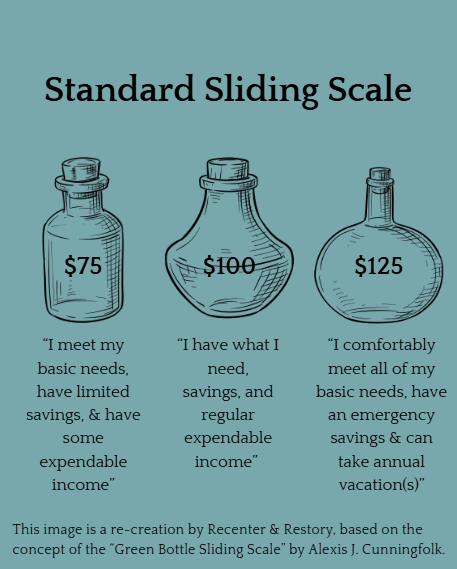
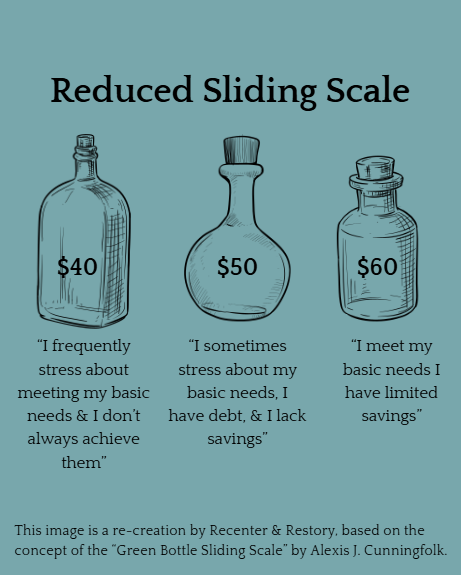
We believe that financial resources, including income, should not be the only determining factor in whether someone can access services. This is why we adapted the model of the "Green Bottle Sliding Scale" for our services. This allows for clients to self-select a fair price for services based on their financial reality (beyond income). Reduced fees for the services below are available from $40-70 through the Open Path Collective. The details for both the standard and reduced fees are outlined below.
-
Individual Therapy Fees
Intake session ($125-175)
Planning session ($100-150)
Follow-up sessions ($75-125)

-
Relational Therapy Fees
Intake session ($150-200)
Planning session ($125-175)
Follow-up sessions ($100-150)

Here is our general guideline to help you determine where you fall on the sliding scale.
Frequently Asked Questions
-
Open Path serves clients who are uninsured or underinsured and whose household income is under $100,000 per year. Clients also pay a one-time membership fee directly to Open Path. Learn more about this on their website, Open Path.
-
Absolutely. We understand that life circumstances can shift, and are always open to having thoughtful, respectful conversations about fees.
-
Absolutely! A superbill is a detailed receipt that includes the information your insurance company may require to reimburse you for out-of-network mental health services. You would submit the superbill directly to your insurance provider, and any reimbursement would be sent to you based on your plan’s benefits. Please note that reimbursement is determined solely by your insurance plan, and Recenter & Restory cannot guarantee coverage or payment for submitted superbills.
-
Yes. FSA and HSA cards are accepted for therapy sessions. You may also use FSA/HSA funds to reimburse yourself for eligible mental health expenses, depending on your plan.
-
No, our sliding scale is centered around accountability and truthfulness, therefore we do not ask for income verification. We ask that you be honest with what you "can pay" and not what you would "like to pay."